Friday, April 1, 2016

Iceland: Land of Fire and Ice

Ready to roam the bitter cold
"Golden Circle" in Iceland
Iceland’s moniker, the Land of Fire and Ice, is well deserved. This little island is home to 130 volcanoes (the fire) and enough glaciers to the cover 12% of the country (the ice). Iceland is one of the most active volcanic areas on earth with a volcanic eruption about every 5 years.

Iceland also has more than its share of earthquakes with 150-400 (tiny) earthquakes each week! Larger earthquakes occur a couple times a year but seldom cause serious damage.
The mountainous, snowy interior of Iceland
Living in such an unstable environment doesn’t seem to worry the laid back residents. Although a guide told us a story about a family who was watching television at home one night when a hot spring suddenly opened up in the center of their living room!

As much as we were enjoying Reykjavik, it was time to get out of the city and check out more of this wondrous place.


The Golden Circle

One of the most popular day tours out of Reykjavik is the “Golden Circle” tour, and now we know why.  This tour includes three of Iceland’s most popular sights: the largest waterfall in Europe (at 62 meters or about 200 feet), the world’s original geyser (aptly named “Geysir”), and a geological marvel called the Mid-Atlantic Ridge (the meeting of two tectonic plates).

Barren snow-capped mountains and frigid temperatures
As we headed out of Reykjavik, the landscape became whiter and whiter with snow covering the ground and enveloping the magnificent volcanoes that rose all around us. Cows and sheep are kept indoors because of the cold (wouldn’t want to have to clean those stalls all winter long!). So the only animals we saw were the small, hardy Icelandic horses commonly called “Volcano Horses.”  The horses are short in stature but very hardy; we were told to never call them ponies or they and their owners will be quite offended!  Our guide told us that in the cities of Iceland there are no subways and no trains.  Icelanders rely on their cars and their good highways.  But out here in the wilderness, they would never have survived in this unforgiving land without these trusty steeds.

"Geysir" erupts about every 5 minutes
Our first stop was to see “Geysir” which is actually the name given to Iceland’s first geyser; a name that all geysers of the world now use.  The site was quite “hot” with steam vents, boiling pools of water, and of course “Geysir” itself which blew its top about every 5 minutes.  We watched it erupt to approximately 50 feet in the air several times. This site is so beloved by Icelanders that our guide told us it was known as Iceland’s Eiffel Tower or Statue of Liberty.

Lovely "Gullfoss" Waterfall in southwest Iceland


Next up was Gullfoss, the Golden Waterfall. We were blown away (almost literally, as the wind was so strong) by this magnificent falls.  The water cascades down dramatically in two stages ending in a narrow canyon. One of the biggest and best waterfalls we have ever seen.

At "Thingvellir", Anne walks in one of the lava
crevices where two tectonic plates are in motion


Our last stop was Thingvellir, a site with historic significance as the location of Iceland’s first Parliament held in 930 AD and a natural wonder in the form of the Mid-Atlantic Ridge. On the ridge, we were able to see the lava-filled rift between two major tectonic plates: the North American and the Eurasian. These two plates are actually drifting apart at this very point, and as a result, Iceland grows in size about an inch a year. Our guide joked that “obviously Iceland will someday take over the world!” This was an amazing place to see the evolution of the earth in action!

Wonders of Southern Iceland

A second day tour took us along the South Coast following the National Ring Road which encircles the outskirts of the island (the center is uninhabitable). Once again, we were amazed by the treasure trove of scenery on this little island.

Skogafoss Waterfall (tallest in Europe)


Our first stop was at the Skogafoss Waterfall. This powerful and wide waterfall drops over 62 thundering meters (about 200 feet). A “cool” aspect of this one is that the base of the falls was covered with ice chips!  This falls is the highest falls in all of Europe.


Black sand beach with unusual basalt flutes protruding

We drove through a frozen wasteland with virtually no traffic to the famous Black Sand Beach. The sand here was a fine, but strangely dark sand from the ever-present volcanic ash; very different from the brown sand we normally see on other beaches. We also made a stop nearby at a black pebble beach with a scenic rock arch on one side and a mountainside of fluted basalt columns on the other. 

The "Solheimajokull Glacier"


As we headed back toward civilization, we stopped to see a glacier tongue called Solheimajokull. It wasn’t the prettiest glacier; it had picked up lava sediment and debris as it slid its way down. But it was quite an invigorating hike against strong, cold wind to see the icy tongue of the glacier. Speaking of the wind, Iceland has some of the purest, freshest air. Sometimes it’s an effort to walk into the wind, but it’s a joy to breathe (even when the wind is practically knocking you over!).


Anne catches a rainbow at "Seljalandsfoss Waterfall"


Our last stop was another gorgeous waterfall, Seljalandsfoss. This falls is a little shorter than the previous one measuring 60 meters (197 feet) high. You can actually walk behind it for a different perspective. Another added bonus was an afternoon sun that created rainbows in the falling water. Absolutely gorgeous!


Our two excursions into the countryside have convinced us that we need to come back to see more. For such a small island, Iceland packs quite a punch!


Lonely-looking Icelandic Churches dot the barren countryside


More tectonic plate action in-and-around Iceland


We saw evidence of geothermal activity everywhere 


Volcano Horses, as they're called,
roam freely around the land 


Snow-covered regions of southwestern Iceland


Geothermal action is common thru out Iceland

More of the black sand beach
and basalt protrusions

Tuesday, March 29, 2016

Roaming around Reykjavik

Cold as it is, Iceland has become quite a “hot spot” for tourists and tourism, growing at an almost alarming rate. Seventeen new hotels are being built in the city at this moment, and skyscraper-height construction cranes dot the city skyline. The city has also become a foodie paradise with over 400 restaurants. To find out what all the fuss is about, we took in several of the top sights.

Hallgrimskirkja church
Hallgrimskirkja

On our very first day, we walked in the cold rain to the famous church, Hallgrimskirkja (dare you to say that three times fast, or even once ha, ha). The church is a modern, concrete, pyramidal-shaped structure -- an architectural stunner and a striking symbol of the city. The church sits on a high point in the town and soars above all the surrounding buildings.

Double rainbow in front of Hallgrimskirkja
(second rainbow is faintly visible above)
We took an elevator to the top of the church spire for outstanding views and got a bonus: double rainbows! We had just been complaining about the rain, but as the old saying goes, without the rain, there would be no rainbows! We couldn’t believe our luck – what an introduction to Reykjavik.


Frank checks out a whale penis
 (could this be a case of penis envy??)


Phallological Museum

A first on our list of stuff to see was the infamous “Penis” museum.  Now before you roll your eyes into the back of your head, this museum attracts quite a crowd of curious but serious folks, anxious to check out the “merchandise.”  Us included. This museum is the only one of its kind in the world.  

A load of dicks at the Penis Museum
An old, Icelandic gent thought it would be a great goof to collect animal penises from all over and put them on display.  Whales, walruses, elephants, horses, reindeer, geese, foxes, mice, and even the very smallest, a hamster penis, are all well preserved in formaldehyde.  The museum even scored one human donation.  If nothing else, it was a fun way to pass the time.

The 80-foot Andrea our transportation to see
the Northern Lights 


Northern Lights

The primary reason we are braving the cold weather at this time of the year is to have a shot at seeing the Northern Lights which can only be seen well during the winter months. Our Icelandair package included a trip out on the water in an 80-foot (or so) tour boat (called the “Andrea”) at night.  The object?  To see the Northern Lights!!  

Anne tries to stay warm in the
miserable weather
Earlier that day, we had hiked around the old town of Reykjavik, and it was sleeting, snowing, and cloudy all around the harbor area.  In each of our minds, there was absolutely no possibility that we would see any Northern Lights tonight.  But as time grew closer to our boat departure time (10 PM), the hotel desk assured us that our boat was headed out for the grand event.  Skeptical, the four of us (Anne, Frank, Amy, and Ted) took a cab over to our departure point at the harbor, and sure enough, "The Andrea" was ready and bound to set sail for Northern Lights territory!  The weather had cleared up a lot and was not very cloudy anymore.  We never would’a thunk it possible!!! 

Glowing Northern Lights
Out on the water, in the darkness of the night away from the bright lights of Reykjavik, we had a chance to see the Northern Lights emerge just above the horizon.  And sure enough, several miles out, the greenish wisps of the Aurora Borealis came into view.  Like swelling waves of lights streaming across the sky, the lights started out dim, then increased in intensity to full brightness, then disappeared in typical “slo mo” fashion, just as they had started.  Then nothing for several minutes; and then back again. Again and again, these dimly lit waves would flare up, intensify, and then retreat from view. 

Standing atop the upper outside deck of the ship Andrea, it was B-I-T-T-E-R cold, and the deck had a sheet of ice covering it.  It was all we could do to hang onto the railings, avoid slipping, and fight the icy cold winds.  Also, the ship pitched and rocked so violently sometimes, it made it even more difficult to hang on.  Photographing the Northern Lights was extremely difficult given these interesting conditions!!  The ship did issue full-length coveralls for warmth, but we were each pretty well suited against the cold.

The Northern Lights "curtains"
We were so thrilled to have seen the Lights at all, but towards the end of our excursion, the Lights gave us one more breathtaking display. The green glow of the Lights stretched and arched across the sky and then turned into what looked like curtains, vertical stripes shimmering and dancing in front of our eyes. What a once-in-a-lifetime experience -- a true Icelandic miracle!

Frank enjoys the Blue Lagoon


The Blue Lagoon

The Eiffel tower is to Paris what the “Blue Lagoon” is to Iceland.  So of course, we had to spend a few hours soaking in the alleged therapeutic waters.  There are many hot springs all over Iceland, but the Blue Lagoon is the most famous, and the most touristy.  We were bussed over to the Lagoon, where we had about an hour of preprocessing time to get into the water.  Standing in line, getting our towels and robes, possible upgrading each person’s package, getting “smart” wristbands, showers (yes, you are required to shower prior to bathing), dressing, and finally, the plunge!! 

Anne freezing outside the Lagoon
As you emerge from the preparation process in your skimpy bathing suit, you are hit by the bitter 30 degree outside temp, which urges you to move yourself quickly into the Lagoon.  Once there, wow!!  Warmth galore.  The Lagoon is this strange milky-blue color about 4 feet deep in most places with steam everywhere rising from the surface.  Sometimes, you find a hot spot in the water and it’s warmer than anywhere else, but other times the area you chose is just lukewarm.  The piles of lava rocks all around the Lagoon add an eerie ambiance to the swim, and the mountainous snow-covered backdrop somehow provided mental coziness to each of us.

Ted and Amy all "gooked up"
Anne, Ted, and Amy decided to follow the two-part facial treatment beginning with a smearing of the cream-like clay “gook” and followed by a green algae mask. Many were doing this and most wanted to try it.  The spa people issued this skin-enhancing, age-defying liquid glop for all who thought it helped.  Frank was a little skeptical on the benefits, so he opted for more proof.  Anne said that her skin had never felt so soft! (Frank didn’t notice any difference.)

Later, a free drink was provided poolside as part of the package, with the hopes that folks would spend more for extra drinks.  That fancy little wrist bracelet had a microchip within, and the bartenders could scan the bracelet as swimmers approached the bar to conveniently add any new charges. All charges are tallied and paid when exiting the Lagoon.  

Frank quaffs a few beers at the Blue Lagoon!
Each of us drank one of their famous (and delicious!) draught “Gull” beers; we learned the true Icelandic pronunciation of the word “Gull” was actually “guht”, and that the word gull meant golden.  Can’t describe how good it felt when that cold, cold Gull beer slid down our hot spring-warmed gullets. Heavenly refreshing!

Gulping down some Gulls!


The romp in the lagoon was soothing and invigorating.  We topped it all off by eating a late meal in the exclusive spa-side “Lava” Restaurant. A final touch was when darkness fell, and the Lagoon glowed with soft blue lighting.  


More pics:


Super atmospheric Blue Lagoon
Ted gets beautified!


Anne soaks in the soothing waters of
the Blue Lagoon
Gull goes perfectly with a green algae mask!


The Blue Lagoon after dark

Monday, March 28, 2016

Hallo Iceland!

Arriving on Icelandair
Our trip to Iceland began at Newark International Airport where we boarded an Icelandair 757 Boeing jet for a 5-hour trip to Keflavik Airport in Keflavik, Iceland.  Only 5 hours to get to Iceland?  Wow, we can’t even get a domestic flight to Los Angeles, California from Newark that will get us there in that short a time!  And the time difference is only 4 hours which is reasonably painless. This puts a whole new spin on taking impromptu getaway jaunts.  Why go to our west coast, when you can go to a fun European place like Iceland in less time?  And the Iceland Air travel costs are much less too.  We may do this more often.

Iceland is self-sufficient on totally renewable energy
At Keflavik’s Leif Ericson Airport, we met up with our travel friends Amy and Ted Warren, then hopped an Icelandic “Flybus” over to the capital city of Reykjavik where we would be staying for our time here in Iceland.  It was early in the morning and still somewhat dark outside, but we saw great scenery as we made the 45-minute drive over to Hotel Klettur in the heart of Reykjavik. We passed by lava-strewn fields looking like piles of rubble, snow-covered mountains, and even a cloud of steam from one of Iceland’s ubiquitous geothermal vents. On arrival, our 6th floor room was ready, and we crashed for the next few hours for a bit of quality rest.

Rainbow over the city of Reykjavik
History of Iceland

Reykjavik is the capital of Iceland and the northernmost capital in the world. During June and July, the sun shines 24 hours a day! Of course, it is just the opposite in the middle of winter. It is so cold here in the winter that the cows are kept inside all winter long. About 300,000 people live in Iceland, and ¾ of them are located in the Reykjavik area. Unemployment here is at a commendable (and unbelievable) 2 to 3%. 

The first inhabitant, a Norwegian Viking, chose the name Reykjavik which means “Smoky or Steamy Bay” because of the steam rising above the waters of the bay. The Norwegian Vikings established a settlement back in 874 AD; they brought along a lot of Irish and Scottish women, so you will see both Norwegian and Celtic influences here.  Many women sport fine red hair.  The indigenous language of Iceland is a developed combo of Norwegian and Celtic, altho just about everyone speaks English as well. 

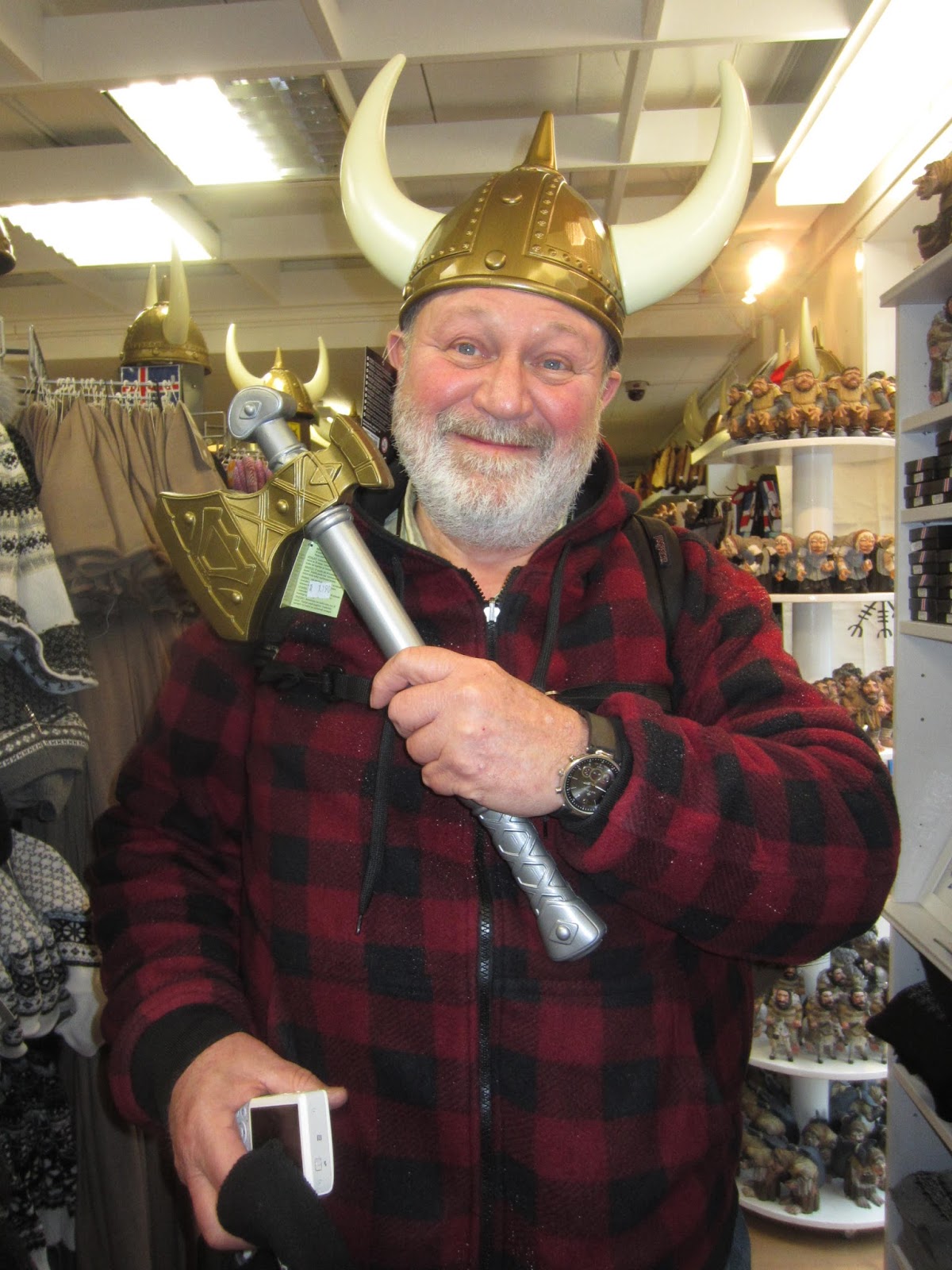
A real Viking barbarian!
The Icelandic word “Vik” means bay.  And the word “Viking” comes from the word Vik because the Vikings were always searching for safe bays. A Viking, contrary to popular belief, was not always a marauding barbarian, wearing a pointy metal helmet with horns, intent on pillaging and warring with others.  A Viking was merely a sailor who explored from bay to bay.  Yes, there were bands of nasty privateering Vikings who raped and pillaged, but that was not the norm.  Basically, they were explorers and traders (at least this is the view Icelanders choose to believe).

After the Vikings degenerated into civil wars among themselves, the island was ruled by the Danes until WWII. On 17 June 1944, Iceland declared itself a free republic. Many Brits and Americans were stationed here during WWII keeping Iceland untouched by Hitler.

All of Iceland operates on free energy 
Natural Resources

Iceland has remarkable natural resources. Almost all of Iceland’s electrical power is provided by renewable energy: roughly 75% from hydroelectric power (lots of waterfalls) and 25% geothermal. This country is very environmentally conscious; its pristine countryside is a badge of honor to each Icelander and a model for the rest of the world. Electricity and hot water are practically free for residents. Molten magma flows just beneath the earth’s mantle in many spots in Iceland creating great reservoirs of potential energy and steam. Unlike the rest of the world that is busy drilling for oil, here in Iceland they “drill for steam!”


At the Blue Lagoon (which we'll talk about next time!)
So we are off to a good start for our Icelandic adventure. As the locals say, “We are happy as a cow in spring!” (For some reason, many of the Icelandic sayings seem to involve cows.)

Wednesday, February 10, 2016

Hallo family and friends,

We are getting ready for a one-week adventure in Iceland with our friends Amy and Ted. You might think that living in the Poconos, the last thing we need is to go somewhere cold, but Iceland is a “hot” destination. And we are hoping to get a glimpse of the Northern Lights. The Lights can be quite elusive, so we appreciate any positive vibes you can send our way!

Here are just a few of the things we have planned:

Northern Lights by Boat -- we'll be crossing our fingers

Blue Lagoon -- our chance to soak in Iceland's super-blue geothermal spa pool

Golden Circle Tour -- an excursion out of the city to see some of Iceland's famed scenery including a waterfall and a geyser

South Shore Adventure -- an excursion to take us even further into the countryside to see a glacier and a black sand beach

Food Walking Tour -- they eat some pretty weird stuff in Iceland like fermented shark and ram's testicles; stay tuned on this one

Phallological Museum -- yes, it's a penis museum; the only one in the world in fact (if you want to know more, watch "The Final Member" on Netflix)

As always, we are thrilled to have you join us on yet another adventure.  As the Icelanders like to say: "There are many wonders in a cow's head." We hope to find a few!

Sjaumst sioar (see you later in Icelandic),

Frank & Anne